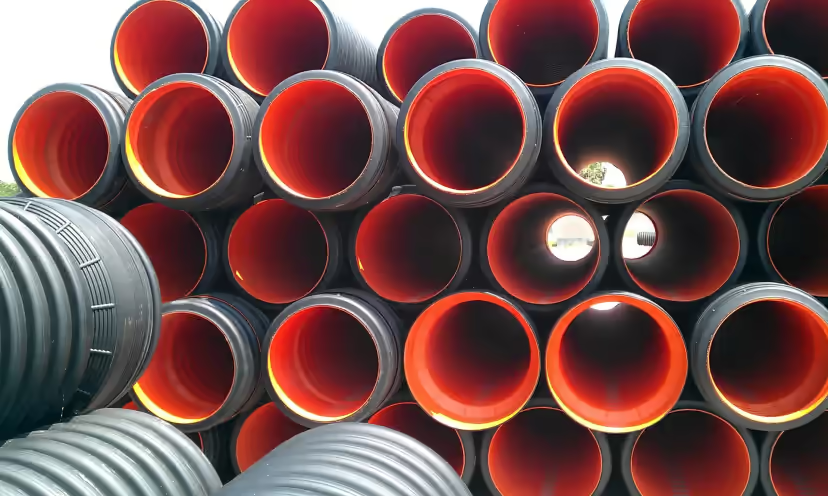
Stormwater Drainage
High-capacity road and city drainage, laid fast before the monsoon.
Overview
Drainage that carries rainwater off streets and paved areas. Chosen where the line has to move a lot of water, go in quickly and last, all on a tight programme.
Specification
- Product range: Alcorr DWC HDPE
- Standard: IS 16098 (Part 2)
- Nominal Size: ID 75 mm to ID 1000 mm
- Stiffness Class: SN 4 / SN 8 / SN 16
- Standard Code: IS 16098 (Part 2)
Why HDPE here
- Carries about 30% more water than concrete of the same size, because the bore is smooth
- Light enough to lay without hiring a crane, so the work fits the pre-monsoon window
- Grit does not wear it and silt does not settle in it
Typical deployments
- Highway median drainage
- Municipal storm networks
- Rainwater discharge mains
- Airport runway sub-surface drainage
Reference project
- Piplihana Urban Drainage Project — Indore, Madhya Pradesh
Specification and site notes
Sizing on the flow coefficient, not the diameter
The smooth inner wall gives a roughness value (Manning n) of about 0.009 against roughly 0.013 for concrete. Re-running the hydraulic calculation on the real n often lets a stormwater line drop one nominal size versus a like-for-like RCC substitution, which is usually where the cost saving actually comes from.
Working the monsoon window
A 6 m length of ID 600 mm DWC weighs a fraction of the equivalent RCC pipe and is handled without a crane. Trenches can be opened, laid and backfilled inside the same shift, which is what makes a pre-monsoon programme achievable on congested urban roads.
Silt and abrasion
The bore does not scale up and grit does not key into it, so the section keeps its design capacity between desilting cycles. Where grit load is heavy (hill roads, quarry approaches), specify SN 8 and maintain the design gradient rather than moving to a thicker wall.
Catch pits and outfalls
Connect into brick or precast catch pits with a puddle collar cast around the corrugation; the ribbed profile keys into the surround and gives a far better seal than a plain-wall pipe cast into masonry.
FAQ
Why is DWC HDPE faster to install for stormwater drains?
Weight. Large-diameter DWC is handled by the laying crew without a crane or heavy lifting gear, so a trench can be opened, the pipe laid and jointed, and the trench backfilled within one working shift. On urban roads that is often the difference between finishing before the monsoon and not.
Does DWC HDPE carry more water than the same size RCC pipe?
For the same internal diameter, yes. The smooth inner wall has a roughness value (Manning n) of around 0.009 against roughly 0.013 for concrete, which is about 30% more flow at the same gradient.
Can stormwater DWC pipes take traffic loads?
Yes, when installed to IS 16098 (Part 2) with the correct bedding and side-fill compaction. Specify SN 8 for carriageway crossings. As a flexible pipe, the surrounding compacted soil carries a large share of the load, so installation quality is what governs performance.
What sizes are used for urban stormwater?
ID 300 mm to ID 1000 mm covers most municipal storm networks; secondary and property connections run from ID 100 mm to ID 250 mm.
Commonly specified sizes
At ID 1000 mm a DWC length weighs about an eighth of the same size in RCC and goes in without a crane, so the biggest sizes are where it beats concrete by the widest margin.
Related applications
See also
For CAD drawings, compliance certificates and B2B pricing estimates, contact mktg@alom.in.
Product Range
Company & Resources