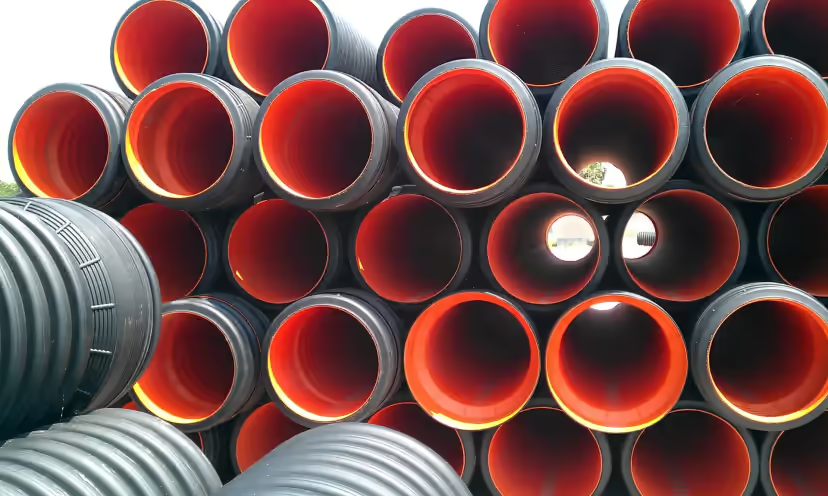
Municipal Sewerage
DWC pipe stiff enough to replace concrete sewer mains.
Overview
Underground gravity sewer networks for municipal bodies, sewerage boards and tier-2 and tier-3 towns replacing old concrete (RCC) mains. Long pipe lengths and sealed joints mean fewer joints and no sewage leaking into the ground.
Specification
- Product range: Alcorr DWC HDPE
- Standard: IS 16098 (Part 2)
- Nominal Size: ID 75 mm to ID 1000 mm
- Stiffness Class: SN 4 / SN 8 / SN 16
- Standard Code: IS 16098 (Part 2)
Why HDPE here
- Sewer gas (H₂S) cannot eat away the top of the pipe the way it does concrete
- Push-fit joints with twin rubber sealing rings, so nothing leaks out
- 75 to 100 year design life underground
Typical deployments
- Trunk sewer networks
- Lateral sewerage lines
- Sewage treatment plant (STP) headers
- Gravity collector lines
Reference project
- Kolkata Environmental Improvement Project (KEIP) — Supplied since 2011
Specification and site notes
Choosing the stiffness class
SN 4 covers shallow lateral runs under footpaths and service lanes. SN 8 is the default for carriageway crossings and burial depths beyond about 3 m. Specify SN 16 where the cover is unusually deep, the water table is high, or compaction around the pipe cannot be guaranteed.
Bedding and backfill
Lay on a 100–150 mm granular bed and pack the same material in around the lower half of the pipe, up to its widest point. DWC HDPE is a flexible pipe: its load capacity comes from the compacted side-fill, so that compaction matters more than the pipe wall itself.
Jointing
Clean the spigot and socket, seat the EPDM sealing ring in its corrugation valley, lubricate, and push home to the witness mark. Never use grease or oil as lubricant: only the approved soap-based compound, which does not attack the rubber ring.
Testing
Air or water testing to IS 16098 (Part 2) can be done immediately after jointing; there is no cure period like a cement mortar joint. That alone typically pulls several days out of a package's programme.
FAQ
Can DWC HDPE pipe replace RCC in a municipal sewer?
Yes. For gravity sewers from ID 75 mm to ID 1000 mm, DWC HDPE is a direct substitute and is what most Indian sewerage packages now specify. It carries the same IS-standard hydraulic duty at roughly a tenth of the weight, and it does not suffer the crown corrosion that shortens RCC sewer life in H₂S-rich mains.
What ring stiffness should a municipal sewer specify?
SN 8 for anything under a carriageway or deeper than about 3 m; SN 4 is adequate for shallow laterals under footpaths. SN 16 is used for deep burials, high water table, or where side-fill compaction is difficult to control.
How are DWC sewer pipes jointed?
By push-fit socket with an EPDM rubber sealing ring seated in the corrugation valley. No welding, no cement mortar, no cure time, so a two-person crew can joint large diameters and the line can be tested the same day.
What is the design life of a DWC HDPE sewer?
75 to 100 years buried. Sewage does not attack HDPE, nor does the sulphuric acid that forms from sewer gas above the flow line, nor aggressive soil. There is no steel in it to rust and no mortar to be eaten away.
Commonly specified sizes
At ID 1000 mm a DWC length weighs about an eighth of the same size in RCC and goes in without a crane, so the biggest sizes are where it beats concrete by the widest margin.
Related applications
See also
For CAD drawings, compliance certificates and B2B pricing estimates, contact mktg@alom.in.
Product Range
Company & Resources