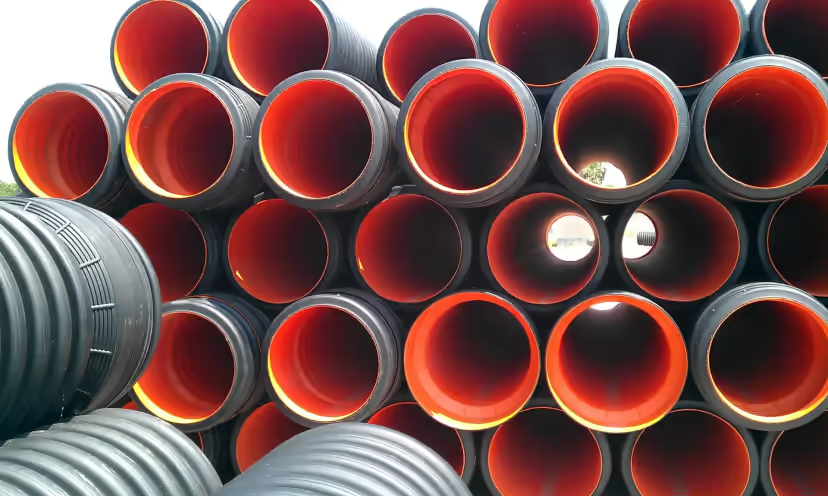
Highway Drainage & Cross-Drainage
SN 8 DWC pipe for burial under Class A highway traffic.
Overview
Cross-drainage culverts, median drains and service-road crossings for NHAI, state highway and expressway packages. Quick to lay, which is what counts when the monsoon sets the deadline.
Specification
- Product range: Alcorr DWC HDPE
- Standard: IS 16098 (Part 2)
- Culvert Sizes: ID 100 mm to ID 1000 mm
- Stiffness Class: SN 8 / SN 16 rating
- Standard Code: IS 16098 (Part 2)
Why HDPE here
- SN 8 ring stiffness carries Class A traffic loads with margin to spare
- Light enough that no crane is needed beside a live carriageway
- Bends with the embankment as it settles instead of cracking
Typical deployments
- Cross-drainage culverts
- Longitudinal median drains
- Service road crossings
- Highway toll plaza utility runs
Reference project
- Border Roads Organisation, Project Dantak — Roadside drainage loops, Bhutan
Specification and site notes
Cover depth governs the class
SN 8 is the working default under Class A traffic at normal cover. Where cover falls below roughly 0.8 m under a carriageway, which is common at a shallow cross-drainage crossing, either raise the class to SN 16 or design a load-transfer slab. Cover, not diameter, is the parameter that decides.
Settlement is a feature, not a defect
Sub-base settlement cracks rigid culverts. A flexible DWC pipe deflects with the embankment and keeps its seal, which is precisely why it survives on new fill where an RCC hume pipe would open at the joints.
Working next to live traffic
Large-diameter DWC is laid without a crane, so lane closures are shorter and there is no swinging load beside running traffic. On a widening package under a monsoon deadline that is usually the decisive advantage.
Headwalls and outfalls
Terminate into cast headwalls with the corrugation keyed into the concrete. Do not cast a plain-cut end flush into masonry: the ribbed profile is what gives the collar something to grip.
FAQ
Are DWC HDPE pipes approved for NHAI highway drainage?
DWC HDPE pipe to IS 16098 (Part 2) is used for cross-drainage culverts, median drains and longitudinal drainage on national and state highway packages. SN 8 is the usual specification under Class A traffic loading, with SN 16 where cover is shallow.
What ring stiffness is needed under a highway?
SN 8 at normal cover under Class A traffic. Where cover under the carriageway falls below about 0.8 m, either move to SN 16 or provide a load-transfer slab. Cover depth is what decides, not pipe diameter.
Will a flexible pipe survive embankment settlement?
Better than a rigid one. New fill settles, and a rigid culvert cracks or opens at the joints when it does. A DWC HDPE pipe deflects with the embankment and keeps its socket seal intact.
What sizes are used for highway cross-drainage?
ID 300 mm to ID 1000 mm for cross-drainage culverts and main longitudinal drains; ID 100 mm to ID 250 mm for median and service-road drainage. ITS and signalling cable on the same package is a different duty: that is Telecorr duct to IS 16205 (Part 24), rated by compression class rather than ring stiffness.
Commonly specified sizes
At ID 1000 mm a DWC length weighs about an eighth of the same size in RCC and goes in without a crane, so the biggest sizes are where it beats concrete by the widest margin.
Related applications
See also
For CAD drawings, compliance certificates and B2B pricing estimates, contact mktg@alom.in.
Product Range
Company & Resources