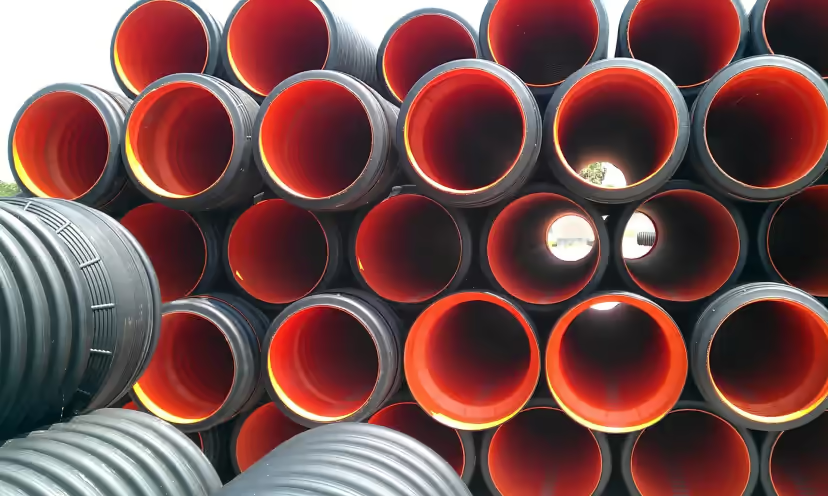
Industrial Effluent Drainage
HDPE that chemicals do not attack, with no steel inside to rust.
Overview
Gravity effluent collection lines for factories, chemical plants, refineries and industrial estates. A direct replacement for steel or concrete drains that have corroded through.
Specification
- Product range: Alcorr DWC HDPE
- Standard: IS 16098 (Part 2)
- Effluent Sizes: ID 75 mm to ID 1000 mm
- Stiffness Class: SN 8 / SN 16 rating
- Standard Code: IS 16098 (Part 2)
Why HDPE here
- Acids, alkalis and most plant chemicals do not attack HDPE
- The smooth bore does not scale up or collect sticky deposits
- Sealed socket joints keep effluent out of the ground
Typical deployments
- Chemical estate sewers
- Plant process effluent collection
- Saline coastal discharge runs
- Automotive factory storm loops
Reference project
- L&T Gayeshpur Industrial Drainage — Larsen & Toubro Plant, West Bengal
Specification and site notes
Confirm the effluent, not just the pH
The great majority of acids, alkalis and salts at room temperature do not attack HDPE. What actually needs checking is how hot the effluent runs and whether it carries solvents. Send the effluent analysis with the enquiry and the specification comes back against that, not against a generic chemical-resistance table.
Temperature limits
Continuous discharge above roughly 60 °C reduces the long-term strength of any polyethylene pipe. Where a process line runs hot, dilute or cool upstream of the collection network, or step the class up and shorten the design life assumption.
Why the old line failed
In an RCC or steel effluent sewer the failure is nearly always the reinforcement or the wall itself, attacked from inside. HDPE has no rebar and no cement matrix, so the deterioration mechanism that condemned the legacy line is simply absent.
Containment at the joint
Push-fit sockets with EPDM rings seal against chemical leakage into the ground. Where the estate's consent requires demonstrable containment, air-test each section on completion and keep the record: it is far cheaper than proving it later.
FAQ
Is HDPE pipe chemically resistant enough for industrial effluent?
For the great majority of acids, alkalis and salts at room temperature, yes. They do not attack HDPE, and there is no steel reinforcement in it to corrode. What is worth checking is how hot the effluent runs and whether it carries solvents; send the effluent analysis and the specification is issued against it.
What temperature can an HDPE effluent drain take?
Ambient discharge is not an issue. Continuous flow above roughly 60 °C reduces long-term strength in any polyethylene pipe, so a hot process stream should be cooled or diluted upstream of the collection network.
Why do RCC effluent sewers fail where HDPE does not?
Aggressive effluent attacks the cement matrix and then the reinforcement, and the pipe loses structural section from the inside. HDPE has neither a cement matrix nor rebar, so that failure mechanism does not exist.
What ring stiffness suits a plant drainage network?
SN 8 for general plant roads and yards; SN 16 where the line runs under heavy vehicle movement areas, tanker bays or deep burial in poorly compacted made ground.
Commonly specified sizes
At ID 1000 mm a DWC length weighs about an eighth of the same size in RCC and goes in without a crane, so the biggest sizes are where it beats concrete by the widest margin.
Related applications
See also
For CAD drawings, compliance certificates and B2B pricing estimates, contact mktg@alom.in.
Product Range
Company & Resources