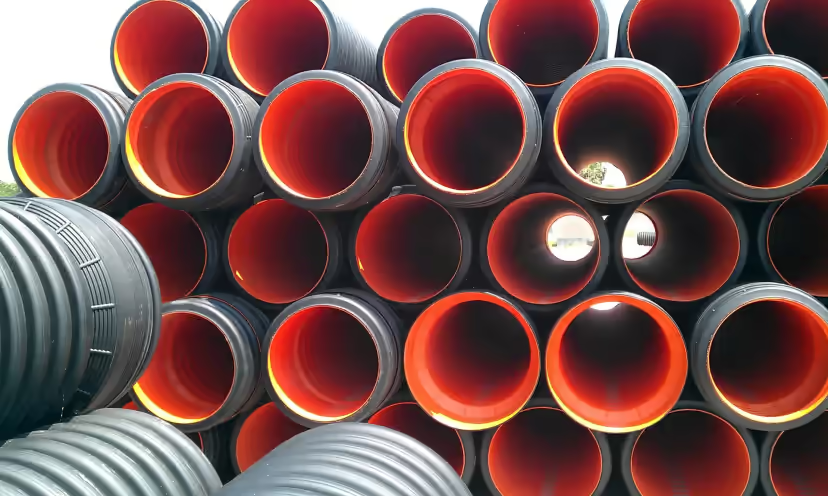
Slurry & Dredging Lines
Wear-resistant HDPE for pumped solids and floating discharge lines.
Overview
Lines pumping slurry, ash, sand and dredge spoil for mineral processing, power station ash handling and river or harbour dredging. Chosen because it wears slowly against gritty flow and because a welded string floats.
Specification
- Product range: QFlow Solid-Wall + Alcorr DWC HDPE
- Standard: IS 4984 / IS 16098
- Pumped Line Sizes: Up to 315 mm OD
- Gravity Line Sizes: ID 100 mm to ID 1000 mm
- Standards Used: IS 4984 + IS 16098
Why HDPE here
- Lasts far longer than steel of the same bore against gritty flow
- An empty welded string floats, so the line is made up on shore and towed out to the cut
- Turning a section moves the worn strip off the bottom of the bore and buys more life
Typical deployments
- Dredge spoil discharge strings
- Thermal power ash slurry lines
- Mineral tailings transport
- Sand and gravel pumping
Specification and site notes
Velocity is the whole design
Too slow and solids settle and block the line; too fast and wear rate climbs steeply. The workable window is narrow and depends on particle size and concentration, so it has to be set from an analysis of the slurry before any pipe is selected.
Rotate the string to buy wear life
Wear concentrates on the bottom of the bore, the invert. Rotating each fused section periodically moves the scar onto fresh wall and can extend service life substantially. Design the supports and the joints so rotation is actually possible.
Floating discharge
An empty capped HDPE string floats, which is what makes a dredge discharge line practical to place: it is fused ashore, towed out and anchored, then repositioned as the cut advances. Once it is running full of slurry the line is heavier than water, so a surface discharge run carries pontoons or clamp-on floats. HDPE's near-neutral density is what keeps that float requirement small.
Ash handling is a chemistry job too
Thermal power ash slurry is alkaline and abrasive at once. HDPE handles both, but confirm the temperature of the discharge, because that is what limits polyethylene, not the pH.
FAQ
Does HDPE outlast steel on a slurry line?
On abrasion, generally yes for the same bore. HDPE's resilient surface deflects rather than being cut by impinging particles, and there is no corrosion running alongside the wear. The trade is a lower pressure rating, so the two are chosen by duty rather than one always winning.
How do you get more life out of a slurry line?
Rotate the fused sections periodically. Wear concentrates on the bottom of the bore, so turning the string moves the worn strip onto fresh wall. Designing the supports and joints so rotation is practical is worth doing at the outset.
Why does an HDPE dredge line float?
An empty capped string does, which is why the line is fused ashore and towed out to the cut. In service it is full of slurry heavier than water, so a floating discharge run needs pontoons or clamp-on floats. HDPE's near-neutral density is what keeps that float requirement small, and the fused line has no joint to work loose under wave action.
What limits the design of a slurry pipeline?
Velocity. Below a certain speed the solids settle out and block the line; well above it the wear rate climbs steeply. The workable window depends on particle size and concentration, so the slurry has to be analysed before pipe is selected.
Commonly specified sizes
At ID 1000 mm a DWC length weighs about an eighth of the same size in RCC and goes in without a crane, so the biggest sizes are where it beats concrete by the widest margin.
Related applications
See also
For CAD drawings, compliance certificates and B2B pricing estimates, contact mktg@alom.in.
Product Range
Company & Resources