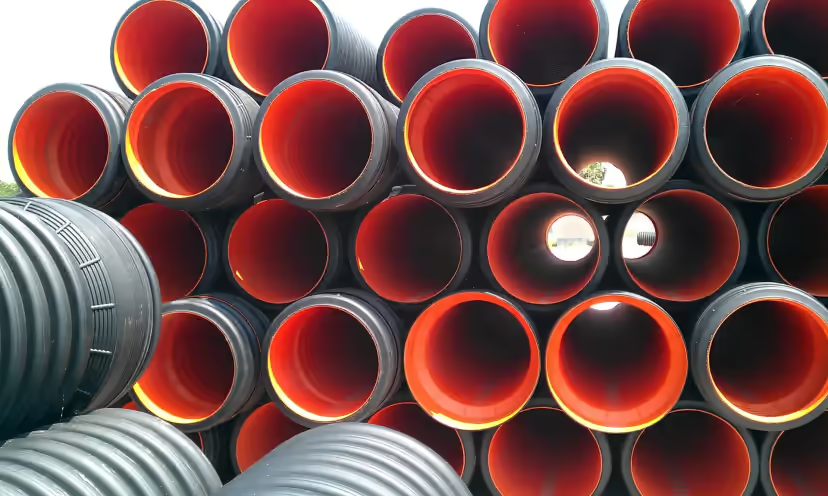
Sewer Rehabilitation & Renewal
Replacing collapsed old sewers in crowded, working city wards.
Overview
Replacing failed brick and concrete sewers in crowded old-city wards, where the hard part is working room and disruption, not the price of the pipe. Short lengths a crew can carry in, open-cut work in narrow lanes and trenchless crossings under live roads.
Specification
- Product range: Alcorr DWC HDPE
- Standard: IS 16098 (Part 2)
- Renewal Sizes: ID 150 mm to ID 1000 mm
- Stiffness Class: SN 8 / SN 16
- Standard Code: IS 16098 (Part 2)
Why HDPE here
- Light enough to carry into lanes no excavator can reach
- Sealed socket joints stop the leaks that wash out the soil under nearby buildings
- Puts in a 75 to 100 year pipe instead of another patch on a corroded one
Typical deployments
- Old-city ward sewer renewal
- Collapsed brick barrel replacement
- Trenchless carriageway crossings
- Property connection re-laying
Reference project
- Odisha Trenchless Sewerage (OWSSB) — Odisha Water Supply & Sewerage Board
Specification and site notes
Survey before you size
A legacy brick barrel is rarely the diameter the record says, and it has usually silted. CCTV survey the run and size the replacement on the catchment as it is now, not on the drawing. Renewal is the one chance to correct an undersized reach.
Handling length is the real constraint
In an old-city lane the limit is what a crew can carry past parked vehicles and shopfronts, not what a crane can lift. Order 6 m sticks rather than 9 m or 12 m for these wards, and stage deliveries daily so the lane is never blocked overnight.
Leaking is why the road settled
A leaking sewer washes fine soil out of the ground around it, which is what causes the road settlement and the foundation cracking that usually triggers the renewal. A sealed socket joint is the point of the exercise, so air-test each reach before reinstatement.
Live connections
Property connections have to be transferred as the new line goes in. Saddle connections onto DWC are made with a purpose-made clamp; do not core and mortar into the corrugation, which is where a renewed line starts leaking again.
FAQ
Why replace a brick sewer with DWC HDPE rather than reline it?
Relining keeps the existing alignment and loses bore. Where the barrel has collapsed, or the reach was undersized to begin with, replacement in DWC HDPE gives back full section, a corrosion-immune material and a sealed joint, for a 75 to 100 year asset instead of another intervention in a decade.
Can DWC pipe be installed in lanes too narrow for plant?
That is one of its main advantages here. A 6 m stick of mid-range DWC is carried by the laying crew, so renewal reaches wards where an RCC pipe simply cannot be delivered to the trench.
How are property connections made into a renewed DWC sewer?
With a purpose-made saddle clamp seated on the corrugation. Coring the wall and mortaring a connection in is what makes a renewed line start leaking again, so it should not be permitted on site.
Does the new sewer need to match the old diameter?
It needs to match the catchment. Legacy reaches are often undersized or silted, and renewal is the only practical opportunity to correct that, so size from a CCTV survey and a current flow calculation rather than from the historic record.
Commonly specified sizes
At ID 1000 mm a DWC length weighs about an eighth of the same size in RCC and goes in without a crane, so the biggest sizes are where it beats concrete by the widest margin.
Related applications
See also
For CAD drawings, compliance certificates and B2B pricing estimates, contact mktg@alom.in.
Product Range
Company & Resources