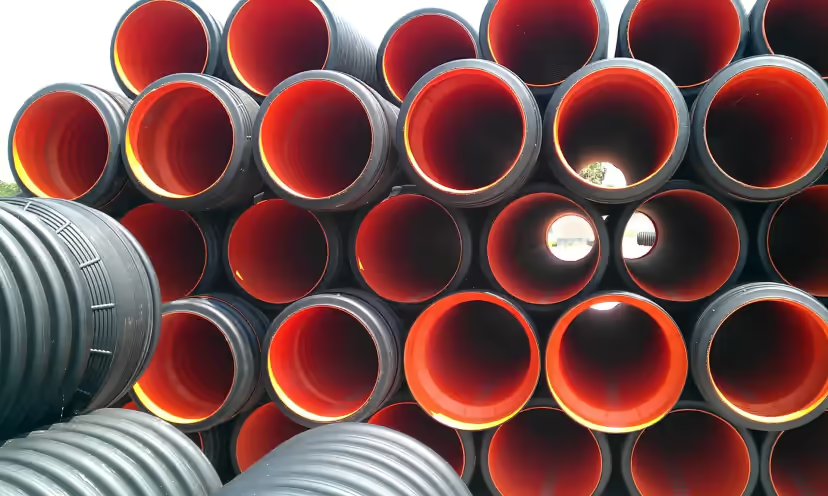
Indian Railways Signal & Power Ducts
Cable ducts that take track vibration and burial under ballast.
Overview
Trackside ducts carrying power, optical fibre and signalling cable. Built to take the weight of ballast, ground that moves and the constant vibration of passing trains.
Specification
- Product range: Telecorr DWC HDPE
- Standard: IS 16205 (Part 24)
- Duct Sizes: ID 50 mm to ID 250 mm
- Standard Code: IS 16205 (Part 24)
- Compression Class: 750N heavy duty
Why HDPE here
- Flexes with ballast load and train vibration instead of cracking
- Rubber-sealed socket joints keep water off the signalling cable
- Does not conduct electricity, so it is safe around power cable
Typical deployments
- Trackside signaling loops
- HV power cable conduits
- Metro railway cable ducts
- Station electrical rings
Specification and site notes
Ballast-zone burial
Ballast transmits point loads and continuous vibration that fracture rigid conduit at the joint. A flexible DWC profile deflects and recovers instead, which is why the failure mode in a ballast shoulder is normally the joint on a rigid duct rather than the duct wall itself.
Always specify 750N
Trackside is a heavy-duty environment throughout: ballast load, tamping machines, maintenance road access. The 450N standard-duty class has no place inside the railway boundary.
Keeping signalling cable dry
Sealed push-fit sockets with an EPDM ring keep the duct bank dry through the monsoon. Water sitting in a signalling duct is a fault-finding problem that shows up months after handover, when the cause is no longer obvious.
Route marking
Lay a warning tape above the duct bank and record the offset from the track centreline. Trackside excavation is done under possession with limited time; a duct nobody can locate quickly becomes a duct that gets cut.
FAQ
Why use DWC HDPE duct trackside instead of rigid conduit?
Ballast zones combine point loading with continuous vibration. A flexible DWC profile deflects and recovers; rigid conduit tends to fracture at the joint. The corrugated outer wall also gives crush resistance without the brittleness.
What compression class do railway ducts need?
750N heavy duty, throughout the railway boundary. Ballast load, tamping and maintenance access all bear on the duct bank, so the 450N standard-duty class is not appropriate inside the track corridor.
Are these ducts safe for power as well as signalling?
Yes. HDPE has high dielectric strength and is non-conductive, so the same range carries HV power feeds, signalling and optical fibre, in separate ducts within a shared bank.
What sizes are used for railway cable ducts?
ID 50 mm to ID 100 mm for signalling and fibre runs; ID 150 mm to ID 250 mm for HV power feeds and multi-cable trunk sections.
Commonly specified sizes
Related applications
See also
For CAD drawings, compliance certificates and B2B pricing estimates, contact mktg@alom.in.
Product Range
Company & Resources