Smart Cities
One trench carrying the sewer, the storm drain and the telecom ducts.
Overview
Shared underground service corridors built under the Smart City Mission, carrying the sewer, the stormwater drain and the fibre ducts under the same road.
Specification
- Product range: Alcorr + Telecorr DWC HDPE
- Standard: IS 16098 / IS 16205
- Sewer Sizes: ID 75 mm to ID 1000 mm
- Duct Sizes: ID 50 mm to ID 250 mm
- Compliance Codes: IS 16098 & IS 16205
Why HDPE here
- One supplier for both the drainage pipe and the cable duct
- The road stays dug up for far less time in busy areas
- Nothing to maintain once buried, so the road is not reopened later
Typical deployments
- Greenfield smart cities
- Underground utility corridors
- Phased metropolitan overhauls
- Multi-utility service ducts
Reference project
- Naya Raipur Development Authority (NRDA) — A brand-new smart city utility backbone
Specification and site notes
Stacking a shared trench
Standard practice is the gravity sewer at invert, stormwater above it where gradients allow, then the pressure water main, with the telecom and power duct bank in the upper 600–900 mm under a warning mesh. Keeping the two DWC ranges from one supplier means one set of socket dimensions and one lubricant on site.
Colour and identification
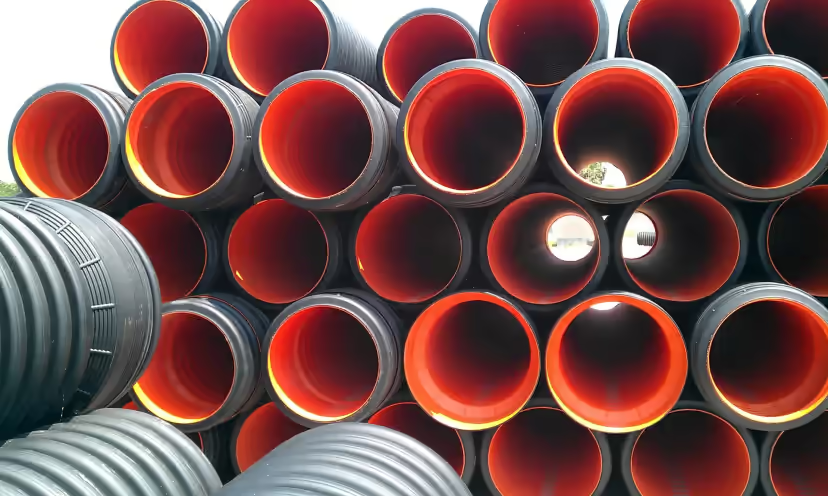
Alcorr sewer and drainage pipe is black with a co-extruded light inner wall; Telecorr conduit is supplied in the orange telecom identification colour. Specifying by colour at tender stage removes the commonest cause of a mis-connected utility during a phased overhaul.
Phasing an existing city
In built-up wards the constraint is how long the trench is open, not pipe cost. Pre-assembling 12 m or 18 m strings on the verge and lowering them in one operation cuts the period a carriageway is broken, which is what the urban local body is actually judged on.
Spare duct capacity
Lay at least one spare ID 100 mm or ID 150 mm duct with a draw rope in every corridor. Adding a duct later means re-excavating a finished road; adding it now costs a fraction of a percent of the package.
FAQ
What pipes go into a smart-city utility corridor?
A gravity sewer and stormwater layer in Alcorr DWC HDPE to IS 16098 (Part 2), a pressure water main in QFlow solid-wall HDPE to IS 4984, and a duct bank in Telecorr DWC HDPE conduit to IS 16205 (Part 24) for fibre and power. ALOM supplies all three, so the corridor comes from one specification and one despatch schedule.
Why does single-vendor supply matter on a corridor package?
Socket geometry, sealing rings and lubricant are consistent across the ranges, so the laying crew works one method rather than three. It also means one set of test certificates for the consulting engineer and one point of contact when a phased delivery has to be re-sequenced.
How much spare duct capacity should be laid?
At least one spare ID 100 mm or ID 150 mm duct with a draw rope, in every corridor. Re-excavating a finished smart-city road to add a duct costs far more than laying it on the first pass.
Does ALOM supply against Smart City Mission tenders?
Yes. Alcorr, Telecorr and QFlow are BIS-certified and TUV India audited, and have been supplied into greenfield smart-city development authorities including NRDA at Naya Raipur.
Commonly specified sizes
At ID 1000 mm a DWC length weighs about an eighth of the same size in RCC and goes in without a crane, so the biggest sizes are where it beats concrete by the widest margin.
Related applications
See also
For CAD drawings, compliance certificates and B2B pricing estimates, contact mktg@alom.in.
Product Range
Company & Resources