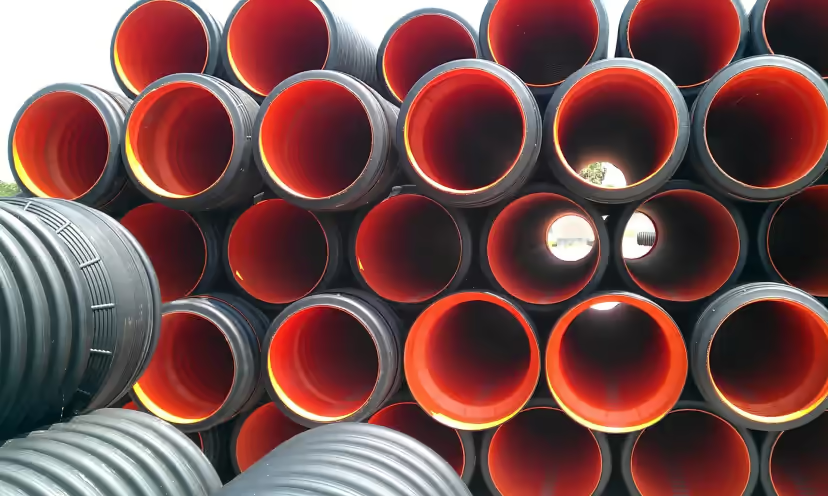
Tube-well Casing & Screens
Corrugated casing that will not rust, scale or collapse in the bore.
Overview
Well casing and slotted screen for shallow and medium-depth tube-wells on irrigated land and rural water supply schemes. It replaces galvanised iron casing, which rusts through, and PVC casing, which turns brittle down the bore.
Specification
- Product range: Alcorr DWC HDPE + QFlow Solid-Wall
- Standard: IS 16098 / IS 4984
- Casing Sizes: ID 100 mm to ID 400 mm
- Stiffness Class: SN 8 / SN 16
- Standards Used: IS 16098 + IS 4984
Why HDPE here
- No rust and no scale to choke the screen slots
- Stiff enough not to collapse under the grout around it and the pressure of the ground
- Light enough to lower without the lifting gear a steel casing needs
Typical deployments
- Irrigation tube-well casing
- Slotted well screens
- Rural water supply wells
- Shallow observation wells
Specification and site notes
Casing and screen are different components
The blank casing seals the bore through the upper ground; the screen is slotted only across the water-bearing layers. Slot size follows the aquifer's grain size and the gravel pack, so the driller's log has to come before the pipe schedule.
Why GI casing fails here
Galvanised iron rusts, and the corrosion products build up across the screen slots until yield collapses. HDPE has nothing to corrode, so the slot area available in year twenty is the slot area that was installed.
Collapse pressure, not internal pressure
A casing string is squeezed from outside by the grout around it and by the ground itself, not pushed from inside. That makes ring stiffness the governing property, which is why a corrugated wall does the job at a fraction of a solid wall's weight.
Verticality and lowering
Lower the string slowly and keep it plumb; a light casing floats and wants to wander. Fill as you go where the design calls for it, and centre the string in the bore before grouting around it.
FAQ
Can HDPE pipe be used as tube-well casing?
Yes, for shallow and medium-depth wells. Corrugated DWC gives the collapse resistance a casing actually needs at a fraction of the weight of steel, and it cannot rust or scale, so screen slot area is preserved for the life of the well.
What is the difference between casing and screen?
Blank casing seals the bore through the upper ground; the screen is slotted and sits only across the water-bearing layers. Slot size is set by the aquifer grain size and the gravel pack, so it comes from the driller's log, not from a catalogue.
Why does GI casing lose yield over time?
It rusts, and the corrosion products accumulate across the screen slots until the open area, and therefore the yield, collapses. A polymer casing has no such mechanism.
What property governs casing selection?
Collapse resistance. A casing string is squeezed from outside by the grout around it and by the ground, so ring stiffness governs, not internal pressure rating.
Commonly specified sizes
Related applications
See also
For CAD drawings, compliance certificates and B2B pricing estimates, contact mktg@alom.in.
Product Range
Company & Resources